Injection Site Guide · GLP-1

GLP-1 Injection Sites
and Rotation

Weekly GLP-1 injections build up fast. Inject in the same spot every week and the tissue there changes — it hardens, thickens, and absorbs medication inconsistently. Rotation solves this entirely.

Approved Injection Sites

Subcutaneous GLP-1 injections (semaglutide, tirzepatide, liraglutide) are approved for three site areas: the abdomen (at least 2 inches from the navel), the upper outer thigh, and the upper outer arm. All three sites offer access to subcutaneous fat tissue and are appropriate for 28-gauge or finer insulin pen needles or syringes. Intramuscular injection is not indicated — inject into the fat layer, not muscle.

Of these, the abdomen is the most commonly used because it's the most accessible for self-injection. The risk is that it becomes the only site — injected weekly, the same abdominal quadrant accumulates scar tissue (lipodystrophy) within months. This appears as firmness or lumpiness under the skin and causes inconsistent drug absorption. Systematic rotation prevents it.
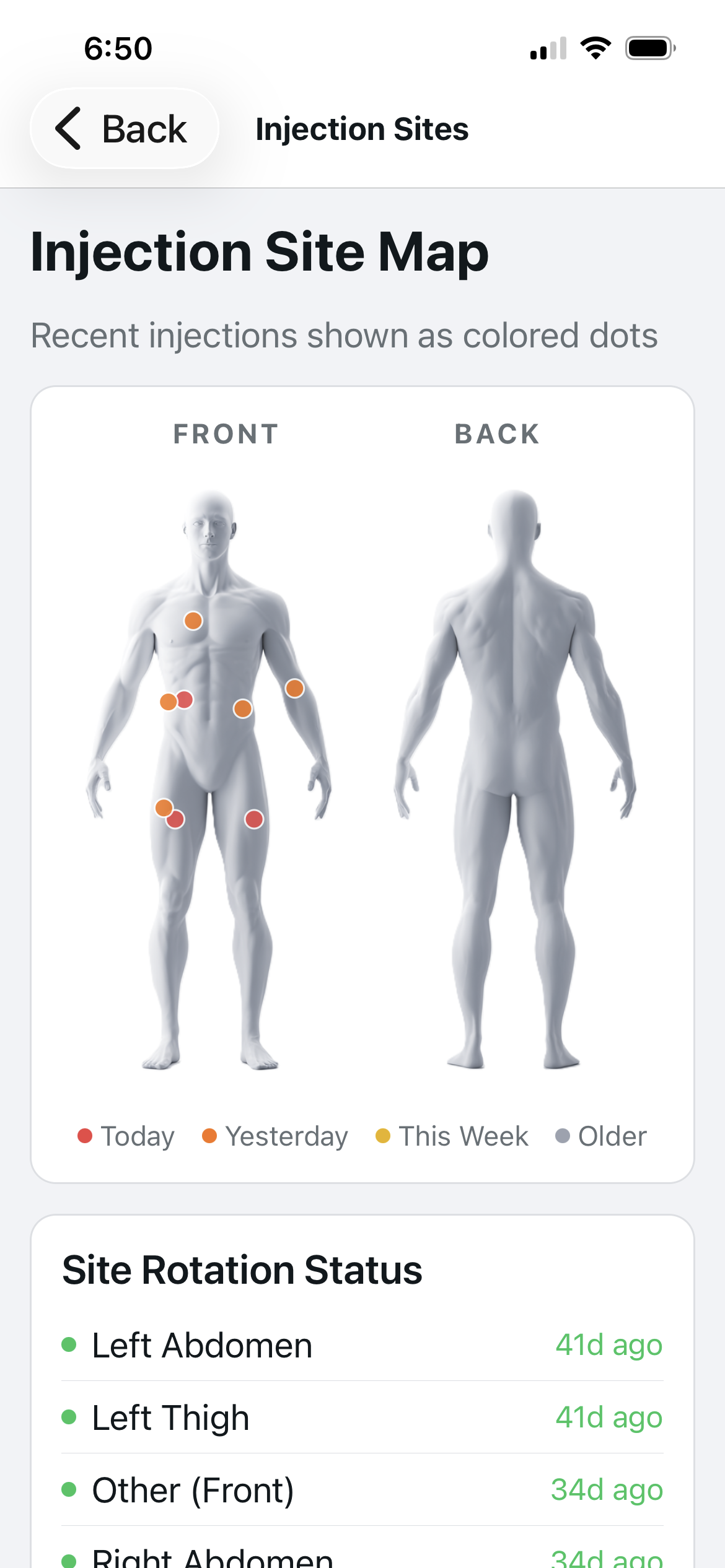
Protocol 3D injection site body map showing rotation zones and injection history for GLP-1 tracking

Protocol's body map tracks every injection and shows when each zone was last used

Rotation Protocol

Use at minimum 4 distinct zones: abdomen left, abdomen right, left thigh, right thigh. Adding upper arm sites (left and right) gives you 6 zones — with weekly injections, each site recovers for 5 full weeks before reuse. This is the optimal rotation for preventing tissue changes on a once-weekly protocol.

Protocol's 3D body map tracks every injection to a specific zone and shows how long ago each was last used. The body map is available on iOS and Android — the only GLP-1 tracking app with this feature.

What is lipodystrophy and how do I know if I have it?
Lipodystrophy from repeated injections appears as hardened, rubbery, or lumpy tissue under the skin at the injection site. It's firm to the touch compared to the surrounding fat tissue. It forms from repeated trauma (needle punctures) combined with the medication's local effect on fat cells. Early lipodystrophy may not be obvious — it develops gradually over weeks to months of repeated injections at the same site. Injecting into lipodystrophic tissue is less painful (the tissue loses sensitivity) but produces inconsistent medication absorption. Systematic rotation prevents formation entirely.
Can I inject semaglutide in my arm?
Yes. The upper outer arm is an approved injection site for semaglutide (Ozempic, Wegovy) and tirzepatide (Mounjaro, Zepbound). It requires access to a subcutaneous fat layer — typically the outer, upper triceps area. Self-injection in the arm can be difficult to position accurately. The abdomen and outer thigh are easier for self-injection. Including arm sites in your rotation adds two additional zones, extending the recovery time between abdominal or thigh reuse.

Track Every Injection Site

3D body map · Rotation history · GLP-1 + peptide logging · iOS + Android

App Store Google Play

GLP-1 tracker comparison →  ·  Full tracking guide →  ·  Protocol tracking guide →